IN THE ARTS
My curatorial work includes exhibitions in Chicago, Baltimore, and most recently Rome, where I also had the opportunity to delve into other sorts of projects, such as literary readings (live and Covid-era virtual) and musical performances. A selection of my Roman projects can be viewed below, and some of my earlier museum work here. I’m particularly proud of my reinstallation of the portrait collection at the American Academy in Rome, which continues to evolve as more portraits enter the collection each year.

Jorge Otero-Pailos, Distributed Monuments, 2022, latex and dust (artwork © Jorge Otero-Pailos)
American Academy in Rome April 13 - June 12, 2022
Rome and its ruins have long provoked an aestheticization of decay—a meditation on the frailty of the physical world and the inevitable passage of time. Regeneration gathered the work of contemporary artists to consider this paradigm with fresh eyes and push up against a paradox: that decay can seed a new, often beautiful materiality, whether of dust, rust, fragments, or weeds. Not far beyond these aesthetic matters lie ethical ones, concerning permanence and transmutation: how we conceive of and value change, and the struggles in choosing what to keep and what to let go.
These perspectives have a particular relevance to Rome and Italy. The Roman ruin is of course an archetype, while ancient Roman industry has left layers of dust still evident in the stratification of glacial ice. As an historic crossroads, Rome is also the nexus of cultural dialogues that span the globe from antiquity to the present. Regeneration invites us to consider this theme in Rome but also across differing geographic contexts, historical frames, and systems of value.
The artists presented in Regeneration represent five continents: Africa, Asia, North and South America, and Europe. They work across scales of time that are equally expansive, from the geologic—the pace at which the earth itself is degrading—to the momentary, a tempo we can register with our eyes and ears. The decline they trace is in some cases sociopolitical, in others environmental, and in others a simple fact of nature and materiality.
Co-curated with AAR interim Andrew Heiskell Arts Director Lindsay Harris. The exhibition can still be experienced virtually, in a bilingual AAR exhibition website and through the (free) Bloomberg Connects art and culture app.
Read my exhibition essay, Coming Apart, and/or listen to a conversation I had with Claire Lyons (Getty Museum) and Webber Ndoro (ICCROM), “Making the Past: Perspectives on Keeping and Letting Go.”

Annalisa Metta and Luca Catalano, Every Nine Days, 2021-22, 12 crude steel plates, natural oxidation (artwork © Metta and Catalano).
NATASHA TRETHEWEY: POEMS for ROME
Villa Aurelia, July 6, 2022
An evening of readings of poems selected by Natasha Trethewey for their special resonance in Rome. The poems—many inspired by paintings and speaking to matters of body, identity, presence, and memory—were newly translated into Italian for this occasion by Alessandro Giammei, read by the poet Silvia Bre, and published by Fuorilinea Editore.
Co-curated with Maria Ida Gaeta, Secretary General of the Committee for the Celebrations of the Centenary of the Death of Dante Alighieri and Founder of the Casa delle Letterature, Rome.

Matteo di Pacino, Saints Cosmas and Damian Altarpiece, left predella: The Miracle of the Transplantation of the Black Leg, ca. 1370–74, (North Carolina Museum of Art, Raleigh)
American Academy in Rome, Villa Doria-Pamphilij, Bramante’s Tempietto June 7 - 17, 2021
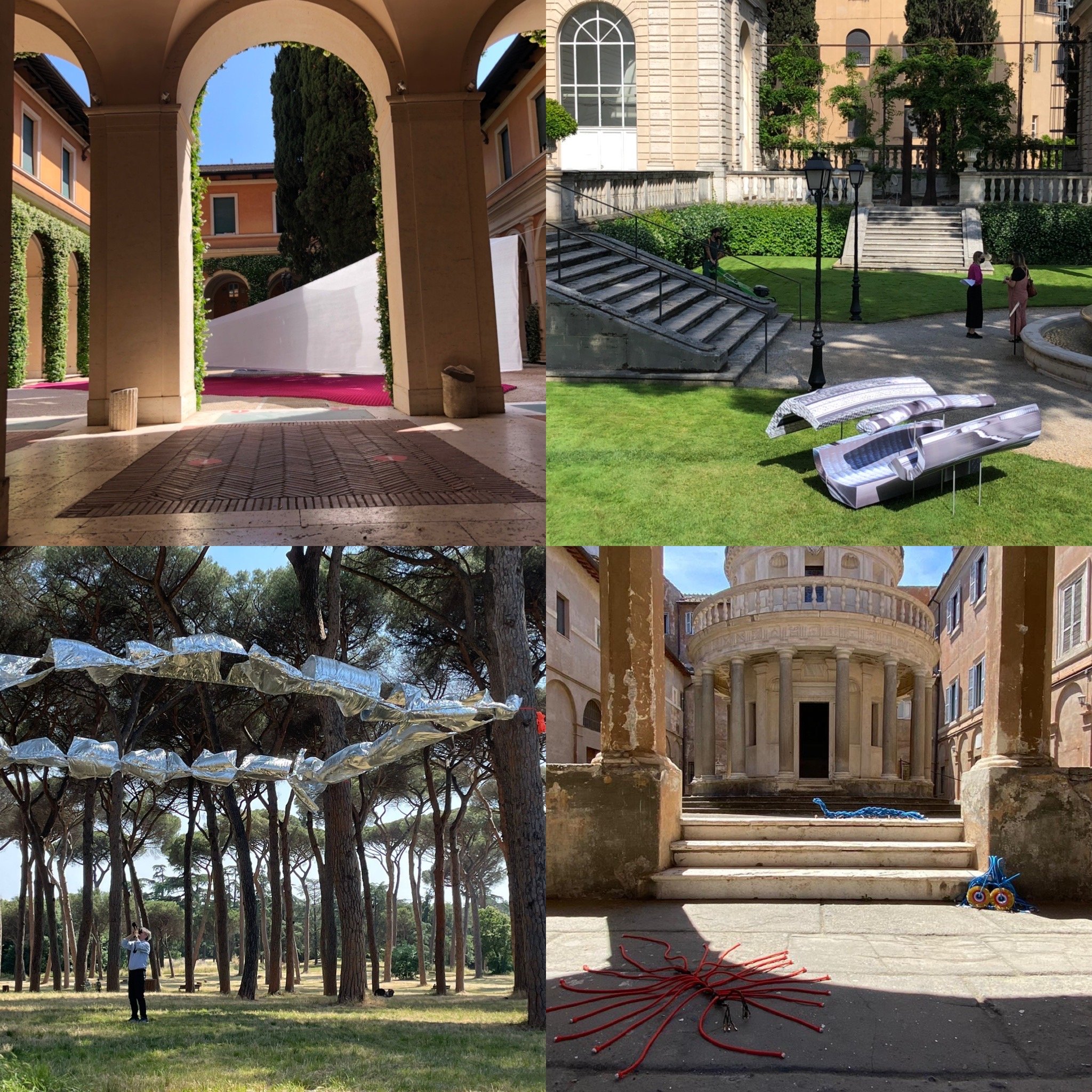
Responding to the restrictions and limits of the COVID-19 era, this exhibition featured the work of four American Academy in Rome Fellows, who produced sculptures for the Academy’s outdoor spaces and other sites in the Monteverde neighborhood. Animating the pine groves of the Villa Doria-Pamphilij Park and the portico of Bramante’s Tempietto at the Reál Academia de España, as well as the courtyards of the Academy’s main building, these site-specific works invited viewers—including residents of Monteverde and passersby—to re-engage with familiar places and explore new vistas. It provided a balance of stasis and movement suitable to the spring of 2021, a time of tentatively hopeful reopenings in Rome.
Download the exhibition brochure here.
Streetscapes installation, clockwise from top left: Katy Barkan, A Mutual Involution of Things; Sara Enrico, RGB (Skin); Corinna Gosmaro, Chutzpah!; Francesca Berni, Nuovissimo Landscape Goes Silver.
WASTE NOT
American Academy in Rome, June, 2021
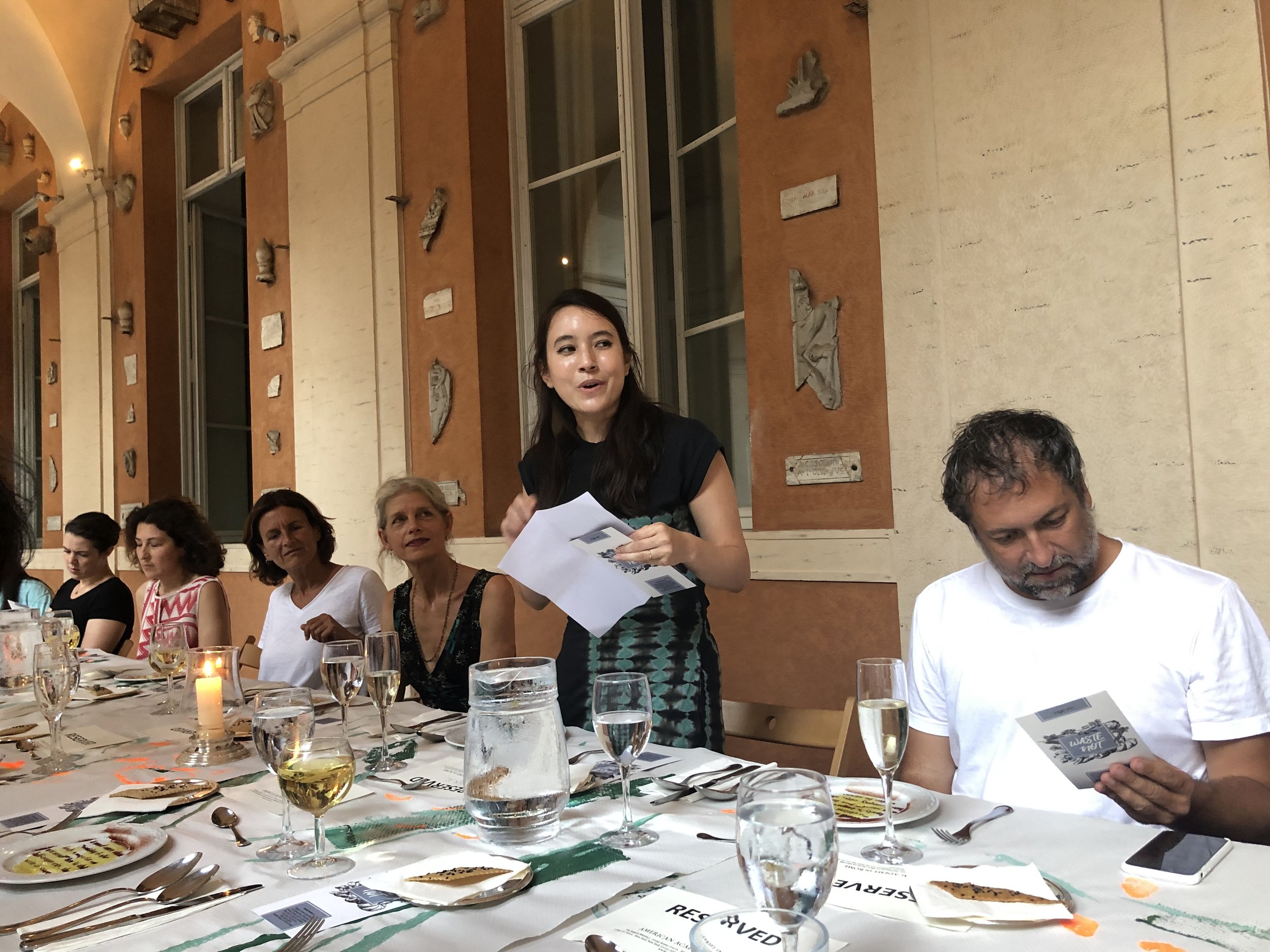
Alexandra Kleeman, AAR Fellow in Literature, organized a five-course meal crafted through poetry, visual arts, music, and food, to call attention to the sense of lost time we all experienced during the pandemic. During a meal made from scraps such as breadcrumbs and vegetable peelings, she read poetry that focused on themes of salvage and the possibility of making something meaningful out of loss. She collaborated with other Fellows who dressed the table and prepared music of “secondary sound,” and with the Rome Sustainable Food project and chef Kyle Pierce to design the menu. It was a fitting send-off to a group of Rome Prize winners who had spent their fellowship year at the Academy during the height of Covid, and I was honored to support it as the Academy’s Arts Director.
ALUMINUM FOREST: SONIC INSTALLATIONS and IMPROVISATIONS
Villa Aurelia, May 20, 2021
I curated this open-air program in collaboration with three Fellows from the American Academy—Katherine Balch, William Dougherty, and Steve Parker—along with composer and improviser Ted Moore and AAR Programs Associate for the Arts Lexi Ebersbacher. The installations and performances responded to the spaces of the Villa Aurelia and the Covid-era need for social distancing.
Download the installation brochure here and, even better, catch some clips on video:
CINQUE MOSTRE 2020: CONVERGENCE
American Academy in Rome, February, 2020
An international set of artists—visual, musical, performance, digital, literary—came together in this iteration of the AAR’s annual Cinque Mostre exhibition that I co-curated with Ilaria Gianni. A large opening night crowd celebrated a fascinating array of work and the brilliance of its creators. Sadly, the exhibition had to close shortly after as Covid-19 made its way to Rome. I am saddened by how short-lived it was, but grateful to the artists and everyone at the AAR who made it possible. I will not soon forget the night of 2-2-2020!
Matthew Brennan and Eugenia Morpurgo, 2100, February 2020 (photograph by Giorgio Benni/American Academy in Rome, Institutional Archives).
Samiya Bashir, I Hope This Helps, February 2020.