PORTRAITS OF THE AMERICAN ACADEMY IN ROME: REINSTALLATION 2020
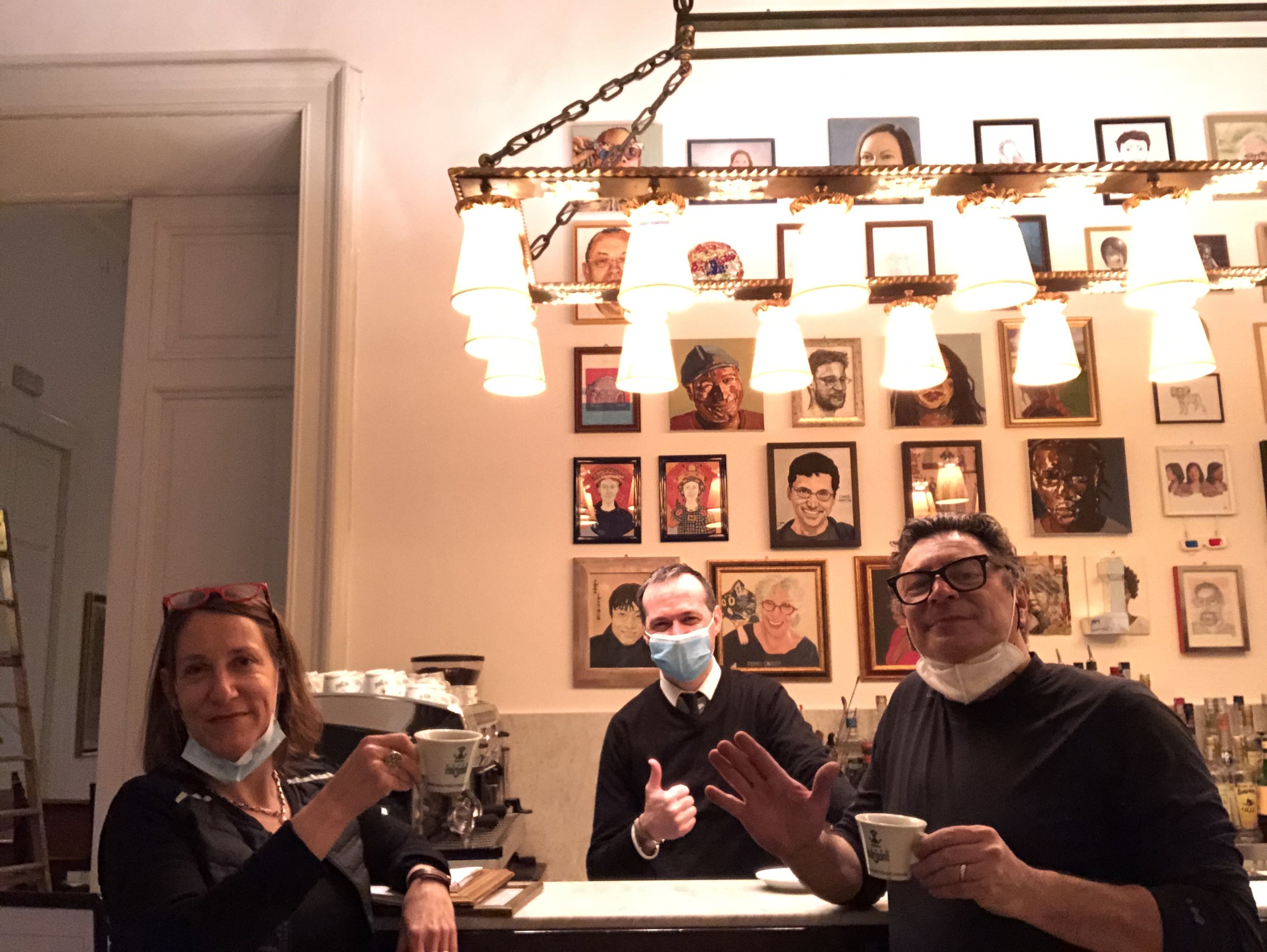
The AAR has a long history of displaying portraits of Rome Prize Fellows behind the bar—a collection that is added to regularly by the Fellows themselves. As the Fellowship classes have diversified so too have the portraits, reflecting the arrival of women artists (not until 1950), artists and scholars of color (1949), and a more varied array of creative practices too. (By tradition, no photographs were permitted, as photography was not fully recognized as an art form.) Change came, gradually, but because the installation of the bar was organic, expanding from the center as portraits we added, the space was still dominated by a “white dude wall.” Signs of an evolving Academy hung at the margins. In 2020 we decided to change that.
Stefano Silvia and I celebrate the reinstallation with a coffee prepared by master barista Alessandro Lima, January 2021. The new installation focuses on the AAR’s present and points to its future, while acknowledging and remembering its past.

Before reinstallation: The portraits behind the bar were the first to be donated to the Academy, and thus represented the Fellowship community as it was in its early years: only white and mostly male. Note also the uniformity of scale, format, and medium.
With encouragement from then AAR Director John Ochsendorf, I began the task of reorganizing the portrait collection. I wanted the installation to be honest and clear about the Academy’s history, but to foreground an inclusive present and future rather than an exclusionary past. After speaking with many constituents—Fellows, regular visitors, and staff—I chose to keep all portraits together, to cluster them in broad chronological groups, and to place the most recent Fellows behind the bar, where they have the most visibility and presence. The historic Fellows are still there, but now face the bar from the opposite wall. There are photographic portraits, group portraits, and soon also a spectacular pair of drawings of the AAR’s first Black Fellows, Ulysses Kay and June Jordan, donated by the artist Whitfield Lovell.


Sorting: Nearly 200 portraits had to be taken down and repositioned, and some that had not been included they were outliers in size or style were added in. Each year, new portraits are donated and today the installation spills into the adjacent billiard room, evidencing the ongoing vitality of the Academy.
Hanging: I took advantage of a quiet moment over the Covid-plagued 2020-21 winter holidays, before the arrival of the 2021 Fellows, to work on the installation, with the collaboration and support of my talented colleague Stefano Silvia.
Click here to see more curatorial projects