BOOKS
COMING SOON
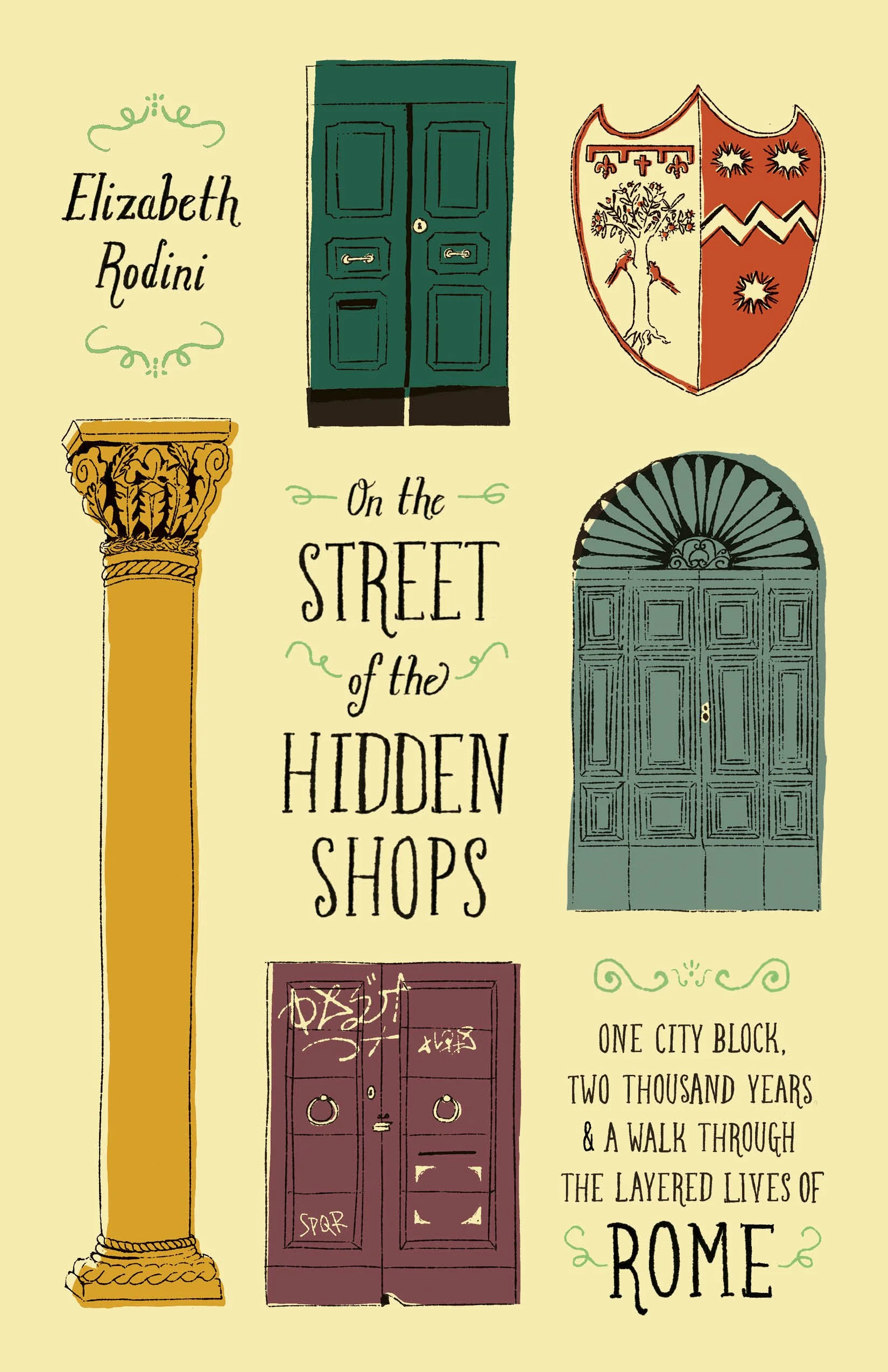
ON THE STREET OF THE HIDDEN SHOPS: One City Block, Two Thousand Years, and a Walk Through the Layered Lives of Rome University of Chicago Press, fall 2026
Rome is a city where history reveals itself in a continuous peeling back of layers, whether in the underbellies of its structures, in archaeological sites, or in museums. The most remarkable of these is the Crypta-Balbi Museum, which occupies a large part of a block in the center of the city.
One winter day, after visiting the museum, I took a stroll around the block. I passed the usual Roman stew of museum, church, palace, historic marker, decay, and debris, but was struck this time by the broad range of stories they presented. I found testaments to the murder of Prime Minister Aldo Moro and the abduction of young Ester Mieli by the Nazis; I watched an unhoused man build a shelter in the doorway of a decommissioned church, a few feet away from a poster protesting the dumping of garbage on the streets; I saw spaces occupied by Polish pilgrims and by hip tourists on e-bikes.
I knew that this same block had housed ancient glassworkers and rope makers, the daughters of prostitutes and other marginalized women, and a second -century latrine. I learned that it had also been a target of fascist city planning and the center of a debate over urban renewal strategies in the 1960s. Many Italians associate the block with the Communist party, and some writers link it to an avant-garde literary journal, Botteghe oscure.
In fact, this block fronts the Via delle Botteghe Oscure, or the “Street of the Hidden Shops,” named for the medieval shops that were set up in the ruined foundations of the Crypta-Balbi theater, built in 13 BCE. The name is apt for a book that seeks to uncover stories that have been forgotten behind and beneath the stones of Rome.
Thank you to the New York Public Library for supporting me and my work through the Vartan Gregorian Center for Research in the Humanities, and to Karen Gantz Literary Management.
GENTILE BELLINI’S PORTRAIT OF SULTAN MEHMED II: Lives and Afterlives of an Iconic Image, Bloomsbury / I.B. Tauris, 2020.
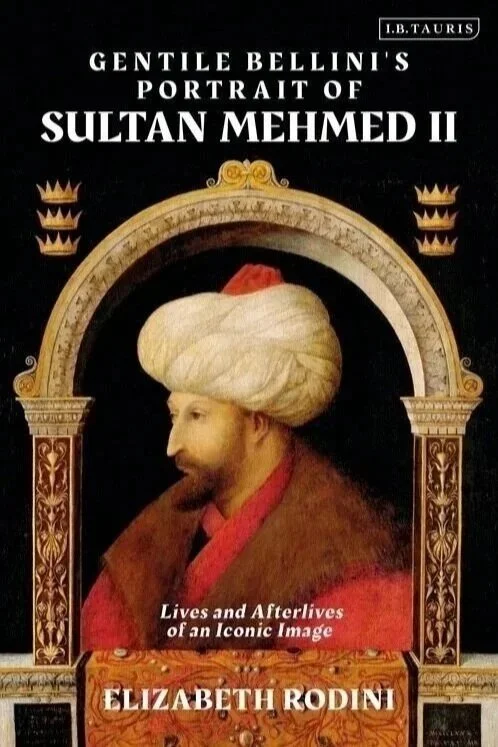
This book recounts the adventures of Gentile Bellini's portrait of Sultan Mehmed II, produced at the Ottoman court, Istanbul in 1480 and hanging today in London. In the intervening years, the portrait got caught up in some key cultural moments: in the activities of the British archaeologist and Orientalist Austen Henry Layard (excavator of Nineveh in Iraq) who purchased the picture in 1865; in early attempts to define national patrimony in Italy; and in a legal debate over the definition of a "portrait" in England. It influenced the Ottoman search for reliable historical imagery in the sixteenth century, and returned triumphant to Istanbul in 1999 in a moment when Turkey was petitioning for membership in the European Union. It is both a renowned picture and a reviled one, an iconic image that has also been marginalized for its poor condition and imperfect provenance.
As indicated in my subtitle, Lives and Afterlives, the book is an object biography, telling the story of Gentile Bellini’s painting while using it as a lens to explore an array of historical and art historical topics, including authenticity, verisimilitude, ownership, cross-cultural exchange, and political identity. It explores global connections, past and present, through a single but endlessly fascinating portrait.
Reviews:
“From time to time a book will inspire us more than most, or convince us that the direction our own thinking has recently taken is worthwhile, or simply engage us in a thought-provoking historical story that is very well-told. Elizabeth Rodini, a distinguished art historian based in Rome, has achieved all this and more with her latest book.” ―Susan Scollay, Emporium
“Elizabeth Rodini's thoughtful account traces the circuitous journey made by the portrait of Mehmet the Conqueror by Gentile Bellini that now belongs to the National Gallery in London … The book fortuitously coincides with the Istanbul Municipality's purchase of a related picture … It is unlikely, however, that its story will be as rich or colourful as the one she tells about the London portrait.” ―Cornucopia
“Rodini manages to be both erudite and personable. She has an eye for the compelling anecdote.” ―Asian Review of Books
“Rodini's study covers the journey of this painting through time and geographies, revealing interactions and encounters between different cultures and politics, and throwing light upon concepts of likeness, symbolism and patrimony ... resulting in a new inspiring reading.” ―Günsel Renda, Professor at the Department of Archaeology and History of Art, Koç University, Istanbul, Turkey.
“Rodini's essential “social life” of the Mehmed II portrait evokes both a memoir and a mystery novel. Her cross-cultural study blends meticulous archival research and rich critical analysis to examine every aspect of this complex painting – from its physicality to its reception spanning its inception in fifteenth-century Constantinople to contemporary London.” ―Lia Markey, Director of the Center for Renaissance Studies, Newberry Library, Chicago, USA.
“Rodini masterfully demonstrates the use of an intertextual methodology for making sense of rumors and traces throughout the book … [and] does not shy away from deep theoretical engagement, revisiting time and again the deceptively simple question of "what is a painting?"” ―21: Inquiries into Art, History, and the Visual
If you’d like to listen before reading, check out these options:
NYU, Casa Italiana, April 2024
Turkey book Talk podcast, November 2020
or read a fuller review here: Asian Review of Books, January 2021